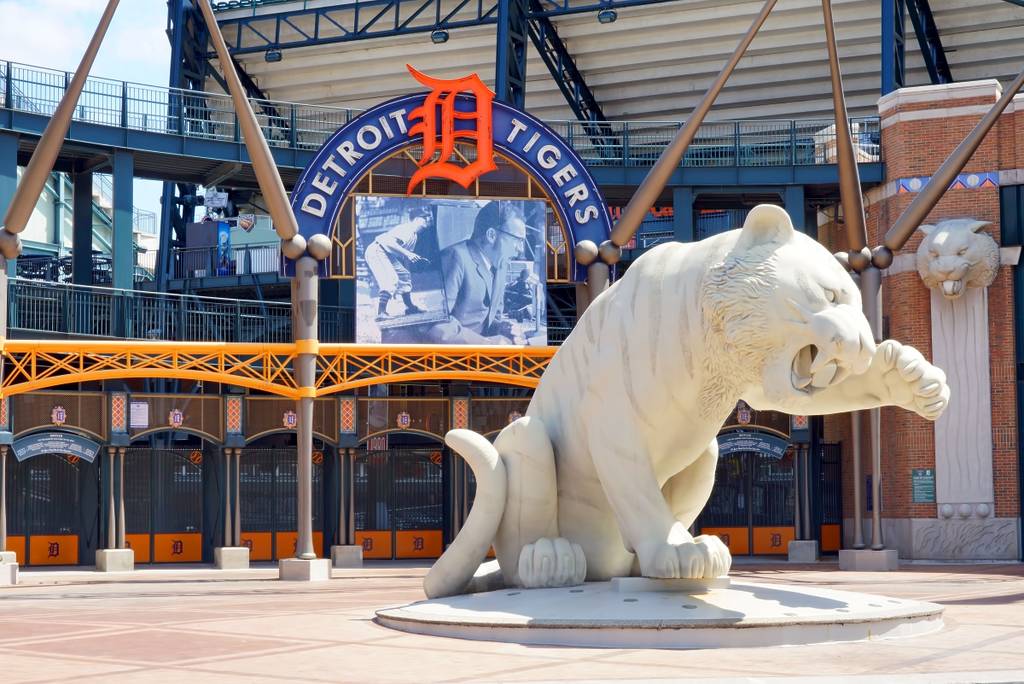

Going to a Detroit Tigers game usually means sunshine, baseball and a few hours outdoors at Comerica Park.
However, according to a new study measuring air quality around all 30 MLB stadiums, the air surrounding Detroit’s ballpark was the worst in Major League Baseball when the study was conducted throughout July.
The study from The Lines tracked hourly levels of fine particulate matter, known as PM2.5, around MLB stadiums throughout the month.
It found that Comerica Park recorded an average PM2.5 concentration of 33.4 micrograms per cubic meter, more than twice the World Health Organization’s recommended daily level of 15 μg/m³.
For Tigers fans who attended all 13 of Detroit’s July home games, the researchers estimated that their exposure to fine-particle pollution was equivalent to smoking 2.1 cigarettes.
What made air quality in Detroit so bad?
The biggest factor behind Detroit’s poor July air quality was elevated PM2.5 pollution, tiny particles that can remain suspended in the air and be inhaled.
The study found that the average PM2.5 reading around Comerica Park was 33.4 μg/m³ during July, putting Detroit well above the WHO’s cited guideline of 15 μg/m³.
Detroit also experienced an especially severe stretch of wildfire smoke during July, as smoke from Canadian wildfires moved into Michigan and pushed air pollution to dangerous levels.
Local reporting said Detroit’s AQI reached hazardous levels during the month, with July 16th producing some of the highest readings recorded in the city.
That made the timing particularly unfortunate for baseball fans, as many of the Tigers’ July games were played while outdoor air conditions were being affected by the smoke.
The study’s comparison with other ballparks was striking.
Comerica Park’s average air quality was more than 12 times worse than the average recorded at San Francisco’s Oracle Park, which ranked as the cleanest MLB stadium in the study.

Has air quality in Detroit improved since then?
The study specifically measured air quality throughout July 2026, so its air quality measurements used in the study represent the full-month average rather than current conditions in Detroit.
The organizers behind the study did not conduct a separate August measurement in the report, however, there is evidence that conditions improved after the worst wildfire-smoke episodes in July.
Local reporting noted that rain brought some relief to Detroit’s air quality after record-breaking pollution levels, although smoke from Canadian wildfires remained an ongoing concern.
In other words, Tigers fans should interpret the study as a reflection of how bad the Canadian Wildfires temporarily made air quality in Detroit, rather than an indictment on the air quality in Detroit as a whole.
The 2.1-cigarette figure was calculated from July’s average PM2.5 levels, a 2.5-hour game duration and all 13 Tigers home games that month.
Still, the findings offer a reminder that air quality can be an important consideration when spending several hours outdoors during periods of wildfire smoke or other elevated pollution.

What was the methodology behind this study?
The study collected hourly PM2.5 readings from OpenAQ monitoring stations located within 10 miles of each MLB stadium throughout the entire month of July 2026.
Researchers averaged those hourly readings and used the resulting figures to rank all 30 MLB ballparks from the most polluted to the cleanest.
To estimate game-day exposure, the study assumed that each MLB game lasted 2.5 hours and calculated exposure using each team’s total number of July home games (Detroit had 13 home games during July).
The researchers then used the Berkeley Earth cigarette-equivalent conversion, which estimates that exposure to 22 μg/m³ of PM2.5 over 24 hours is roughly equivalent to smoking one cigarette.
The study stresses that these cigarette equivalents are a comparative estimate of particulate pollution exposure, rather than a literal claim that breathing outdoor air is identical to smoking tobacco.
The study also surveyed 3,000 U.S. baseball fans on July 31st to examine how often fans check air quality and how pollution and extreme heat affect their decisions to attend games.
64% percent said they never check air quality before attending a game, while 40% said they had skipped a game because of extreme heat or poor air quality.